Credit & lending automation
How to build a lending platform as one flow: NeoFin, from application to repayment
NeoFin is a lending automation platform built and operated by Logics7. A note on why application, decisioning and servicing have to be designed as one flow, and what that decides before anyone writes code.
NeoFin — a lending automation platform built and operated by Logics7. Financial licensing remains with the relevant operator and jurisdiction; the product and workflow execution are Logics7’s. This note describes the product logic and makes no claims about any lender’s results.
Key points
- How to build a lending platform: design application, decision, documents, disbursement and repayment as one flow on one record.
- Every seam between separate systems adds manual work, errors and audit-trail gaps.
- The licence stays with the operator; the product and workflow execution are Logics7’s.
The usual answer to how to build a lending platform is a list of modules: a front-end, a scoring engine, a document tool, a servicing system. We start from the other end. Lending is one flow — application, verification, decision, documents, disbursement, repayment — and the platform has to be designed as that flow before it is split into components.
NeoFin, the lending automation platform we build and operate, shows what that means: where the seams break, what decides build versus buy, and what else the model fits.
What NeoFin is, and who holds the licence
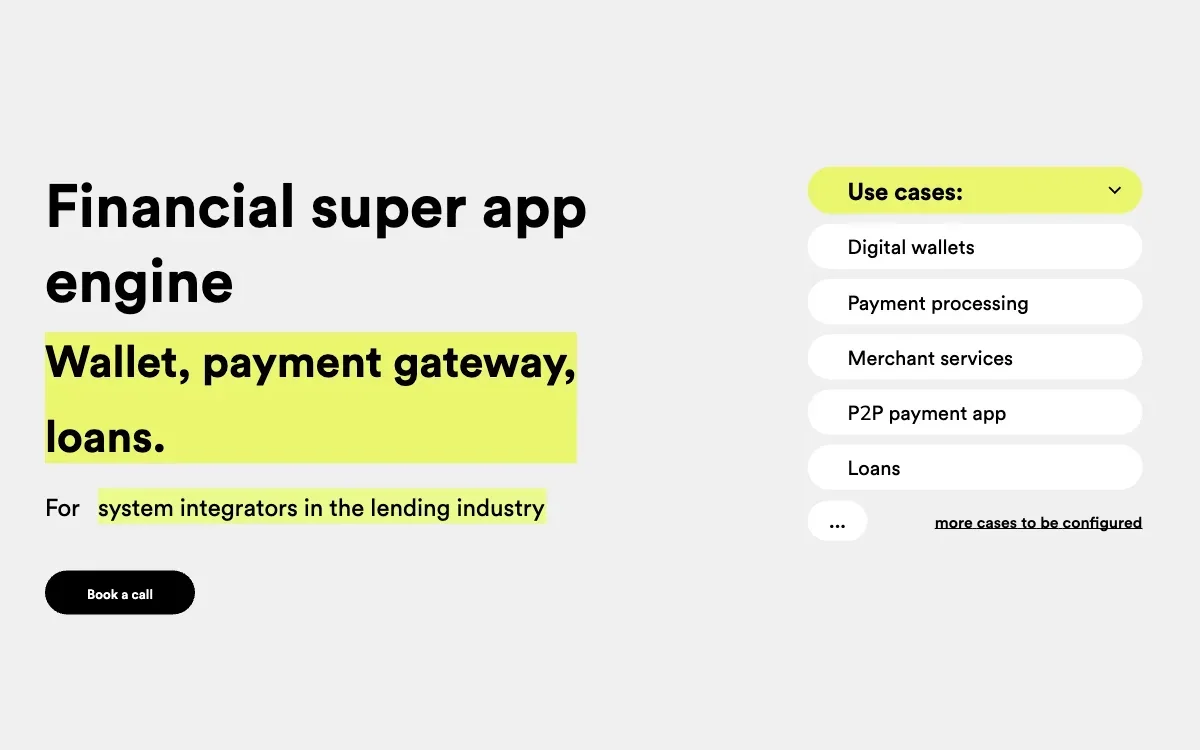
NeoFin is a cloud platform that covers the lending cycle from the application — online, in a mobile app or at a branch — to repayment, servicing and the handling of overdue accounts. One data model underneath, one flow on top: the lender sees the same record from application to repayment.
It is built from components, not as a monolith: 10 pre-built components, among them digital onboarding and KYC, a product builder, an underwriting studio, CRM and BI, a data-source connector, past-due tracking and document management. It carries 3 product lines — wallet, payments and loans — and 8 loan types on one core: payday, consumer, POS and BNPL, credit cards, microfinance, instalment, peer-to-peer and lines of credit.
The licence is not ours. Financial licensing remains with the relevant operator and jurisdiction; NeoFin runs under the operator’s licence in each market rather than replacing it. The product and the workflow execution are Logics7’s. Screens and modules are in the NeoFin case study.
How to build a lending platform: the lifecycle as one flow
Every loan product runs the same chain. Rebuild it for each new product and every launch becomes a project; every rule change touches several systems. The alternative is one flow on one record, where each stage reads what the previous one wrote.
- 01ApplicationOnline, in a mobile app or at a branch.
- 02VerificationApplicant data and identity checks (KYC).
- 03Scoring and decisionRules set in the underwriting studio.
- 04Documents and signingElectronic documents and e-signature.
- 05DisbursementThe approved loan is paid out.
- 06Repayment and servicingRepayments, past-due tracking and collection.
Application and KYC
The record starts here. NeoFin takes applications online, in a mobile app or at a branch, with forms and identity checks for web and mobile. Every channel should write to the same record, so a branch application is not re-keyed later. KYC and AML obligations sit with the lender; a platform should capture the evidence once and keep it with the loan.
Decisioning and underwriting
Credit scoring and the decision run in the underwriting studio and decision engine; third-party data enters through the data-source connector. The credit policy — who qualifies, what is affordable, on what terms — is a set of rules the business can read and change without a release. That separates a credit decisioning engine from a scoring call buried in code: the decision can be audited when someone asks why it was made.
Documents, signing and disbursement
Loan documents are issued electronically, signed and kept with the application; document management and e-signature are part of the platform. Disbursement refers to the same record as the decision and the document, and the wallet and payment gateway run on the same engine as the loans.
Servicing, repayment and collections
After disbursement the loan becomes a servicing task: repayments against the repayment schedule, past-due tracking and collection. This is where a loan management system (LMS) usually takes over from the loan origination system (LOS), and where many platforms split the record. In NeoFin, loan origination, loan management and loan accounting sit on one data model, so loan servicing and collections work from the history the decision was made on.
Why lending modules break at the seams
Most lenders stitch together a front-end, a scoring vendor, a document tool and a servicing system. Each can be good on its own; the seams are the problem. Every hand-off is manual work, delay, error and a gap in the audit trail. Borrower records duplicate, and one credit-policy change has to be made in several places.
| Stage | Data it produces | Usual owner | What breaks when split |
|---|---|---|---|
| Application and KYC | Applicant data, identity evidence | Sales and onboarding | Re-keying; duplicate borrower records |
| Scoring and decision | Score, decision, reasons | Credit risk | Reasons lost; gaps in the audit trail |
| Documents and signing | Signed loan agreement | Operations and legal | Signed terms drift from approved terms |
| Disbursement | Payment instruction and confirmation | Finance | Payouts not matched to an approved record |
| Repayment and servicing | Repayments, arrears, collection history | Servicing and collections | Collections cannot see the original decision |
This is the practical core of how to build a lending platform. NeoFin was designed so that the decision, the document and the payment refer to the same record: the process behaves the same way every time and stays auditable. Speed follows from that; it is not the goal in itself.
Build vs buy: what decides it
Build vs buy lending software is rarely a clean choice. A white-label loan management system is quick when your process matches the product. Loan origination software development from scratch pays off only when the lending logic is your advantage. Configuring products on one core sits between the two. For any digital lending platform, three questions decide the route.
Licensing and jurisdiction
Software does not carry a licence to lend. Licensing, data protection and consumer-credit rules differ by market; in the UK, for example, consumer credit firms need FCA authorisation. Decide who holds the licence before you decide how to build a lending platform: the software has to fit that operator’s compliance obligations, not the other way round.
Who owns the decision logic
The credit policy is the business, not an implementation detail. If the rules live in a vendor’s code, every change waits for a release. In NeoFin, loan products, scoring rules and flows are set in the product builder and the underwriting studio, so a rule change does not have to become a release. Someone still has to own the exceptions.
The third question is who runs it. Integration with accounting and core systems has to be designed, not bolted on, and the platform has to be monitored, released and supported. That is ongoing work, which is why we operate NeoFin rather than only shipping it.
What this model can be built for
The same structure — one record, components on one engine, rules the business owns — serves other lending automation products:
- Lending platforms for banks, microfinance institutions and credit cooperatives
- Buy-now-pay-later and merchant credit
- Embedded lending inside marketplaces and platforms
- Internal credit-decision tooling
- Servicing and collections workflows
We build these as products to be operated: no development without product logic. For a new lending product, Product Partnership first checks whether it has a market, a paying user and a path to launch, before any decision on how to build a lending platform or scope an MVP. If your lending process runs on hand-offs between systems, start with the process, not the tool: Annual Product Operations. For a live lending product with users that has stalled, Existing Product Review is how Logics7 decides whether to take a stake.
Questions readers ask
Do you need a licence to run a lending platform?
Usually, yes, if you lend: consumer lending is regulated in many markets, and the licence belongs to the lender, not to the software. In the UK, consumer credit firms need FCA authorisation. NeoFin runs under the operator’s licence in each market. Check the rules for your jurisdiction with a regulatory adviser; this is not legal advice.
Should you build or buy loan origination software?
Buy when your process matches the product; build or configure when your credit policy, loan range or market is your advantage. First decide who holds the licence, who owns the decision logic and who operates the platform after launch. Those answers shape how to build a lending platform more than the choice of stack.
What is the difference between an LOS and an LMS?
A loan origination system (LOS) takes a loan from application to decision and disbursement; a loan management system (LMS) runs it afterwards: repayments, servicing, past-due accounts and accounting. When they are separate products, the record splits at disbursement. NeoFin keeps loan origination and management on one data model, with one record from application to repayment.
Written by

Kostiantyn Halynskyi
Chief Product Officer
Turns business logic into product structure, designing and shipping in the same pass.
Meet the team
Working on something similar? Start a conversation.
A new product, a business process, a live product, a grant application or an introduction — a few lines are enough to find the right next step.
We reply within one working day.