AI sales automation
Signal-based prospecting beyond LinkedIn: how Vendo AI signal hunters work
Vendo AI, a Logics7 product, now reads buying intent from many public sources, not one network. A product note on signal-based prospecting: what signal hunters are, why each is opt-in, and what the model is for.
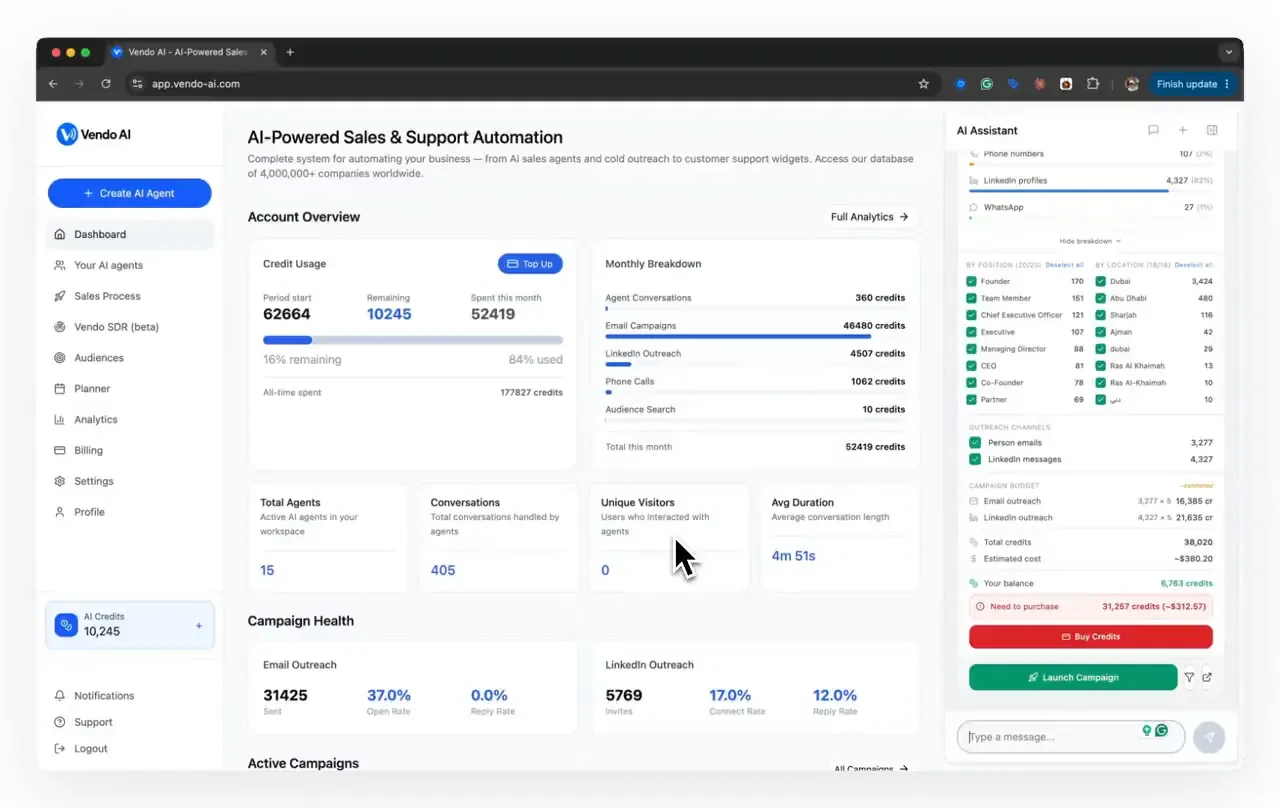
Vendo AI — Logics7’s autonomous AI sales product, co-founded by Logics7’s founder; Logics7 builds and operates it. This note describes a product release of 7 September 2026 and makes no claims about any customer’s results.
Key points
- Signal-based prospecting starts from a public sign of buying intent, not a static list.
- Vendo AI’s signal hunters read many public sources, so no single network decides whether outreach works.
- Every hunter is an opt-in module, switched on deliberately, one source at a time.
Signal-based prospecting starts from evidence that an account may have a reason to buy now, not from a list of names. Vendo AI, Logics7’s autonomous AI sales product, is live in production: six outreach channels, meetings on Google Meet and Zoom, 145+ languages. Its release of 7 September 2026 rebuilt the layer that finds those signals: the signal hunters.
This note explains what signal-based prospecting is, why a system that depends on one network is fragile, how a signal hunter turns a public signal into a conversation, and why every source is opt-in.
What is signal-based prospecting?
Signal-based prospecting is outbound work that starts from a buying signal: a public, dated event suggesting that an account has a reason to change now. A new executive, a hiring push or a new appointment in a company registry is a trigger event. The seller acts while the event is recent and can say why the timing matters.
Buying signals come at two levels. Account-level signals describe a company: it is hiring, it has made an appointment, it appears in a listing. Contact-level signals describe a person: a leader who changed jobs, someone who engaged in public with a topic, a developer who described a problem in a public issue. Intent data is the wider term: first-party intent comes from your own channels, third-party intent from elsewhere. A signal matters only when the account also fits your ideal customer profile (ICP).
A list says who could buy. A signal says who has a reason to talk now. Signal-based selling carries the same idea through the whole sales cycle; this note stays with the prospecting step.
Why one network is not enough
Most outbound systems have a single point of failure. They find people on one professional network, and the day that network throttles an account, the pipeline stops. The dependency is invisible while it works and total when it does not. An AI SDR built on one network inherits that limit.
There is a second cost. Many buyers are not on a professional network at all. A salon, a clinic or a restaurant may have no website and no profile, and a system that reads one network never sees them. Tools siloed by channel add a third problem: the pipeline leaks at every hand-off between human and software.
So Vendo AI’s signal layer was rebuilt to read buying intent where it actually appears: in many public places, in many countries, without leaning on LinkedIn accounts. No single source decides whether the system works today. That is what AI prospecting beyond LinkedIn means in practice.
What a signal hunter is
A signal hunter is a module that watches one public source for a specific kind of buying intent and turns it into a contact or a company worth a conversation. The 7 September release adds six hunters and improves two. Each hunter is a separate card in the product with its own analytics line.
Sources
| Signal | Public source | Why it matters |
|---|---|---|
| Topic engagement | Public engagement with posts on topics a buyer cares about | Shows who pays attention to the topic |
| Executive job change | Job changes in the last ninety days | A new leader is a new budget |
| Hiring activity | Job boards across nineteen countries | Hiring means growth |
| New appointment | Public corporate registries in the US and the UK | A strategic window |
| Public issue | Developer communities | Can name the person who has the problem |
| Local listing | Local business listings | Reaches businesses with no website or network profile |
From signal to action
A signal is useful only if it ends in a conversation with the right person. In Vendo AI that path has five steps.
- 01Source switched onOpt-in module, switched on deliberately, one source at a time.
- 02Signal detectedA hunter watches one public source for one kind of intent.
- 03QualificationThe signal becomes a contact or company worth a conversation.
- 04OutreachOne agent, six outreach channels, 145+ languages, same context.
- 05Meeting or human hand-offGoogle Meet or Zoom; real-time hand-off to a person.
Detection and qualification are the hunter’s job. Outreach is the agent’s: one agent operates across the outreach channels and the meeting channels with the same context, so nothing is re-explained at a hand-off. The agent is trained on the client’s own site: Deep Scan reads up to 15 pages and generates an 8-stage sales script in 4 tone styles. When a conversation needs a person, it passes to a human in real time. CRM and calendar integrations close the loop.
Signal decay
A signal is a claim about timing, and timing expires. A job change is a window, not a permanent state; that is why the executive-change hunter reads changes from the last ninety days. An older signal explains less about why a buyer would talk now, so prioritisation should weigh its age as well as its type. Because each hunter has its own analytics line, an operator sees exactly which source produces what, instead of one blended total.
Why opt-in, and why international by design
Two rules are fixed in the architecture. First, every new hunter is off by default: visible to every account, switched on deliberately, one source at a time. A growth system should never surprise the person accountable for it. Opt-in prospecting makes each new source a decision with an owner.
Second, no hunter may be single-country. A source that exists in only one market can serve only as a backend of a multi-country module. The rule matches the product’s reach: the agent works in 145+ languages, and job boards are read across nineteen countries.
Signals are public; how they are used is governed by the operator’s lawful basis and the rules of each platform. For the UK, the ICO explains how data protection and electronic-marketing rules apply in its guidance on business-to-business marketing. Nothing in this note is legal advice.
What this proves, and what it can be built for
Vendo AI is Logics7’s own product. This note claims no reply rates, meetings or revenue for anyone. What the release shows is narrower: an AI sales system operated as a product, with releases, controls and accountability, not a demo. That is what “AI is our stack; responsibility is our product” looks like in practice. The Vendo AI case study lists the modules, channels and interface.
The same model, signal-driven growth systems with opt-in sources and per-source analytics, is what we build for companies whose sales depend on people and spreadsheets: AI lead qualification, an AI SDR assistant, meeting booking, follow-up automation, CRM updates. For an existing company that is the Annual Product Operations route, which starts from the business process rather than the tool. For a new standalone sales product it is Product Partnership, where we check the product logic before any code is written.
Questions readers ask
What is signal-based prospecting?
Signal-based prospecting is outbound work that starts from a buying signal, not a contact list. A signal is a public, dated event, such as an executive job change or a hiring push, that suggests an account has a reason to talk now. The seller acts while the signal is recent.
What counts as a buying signal?
A buying signal is a public event that suggests a reason to change now. Vendo AI’s hunters read engagement with posts on a buyer’s topics, executive job changes in the last ninety days, hiring on job boards, appointments in corporate registries, public issues in developer communities and local business listings.
Is signal-based prospecting compatible with GDPR?
It depends on the lawful basis. A signal can be public and still be personal data, so using it needs a lawful basis, and electronic marketing has its own rules, which differ by country and by type of recipient. Check both before a campaign. This is not legal advice.
Written by

Dmitry Zhuravlev
Head of Sales Automation
B2B growth systems: AI SDRs, outbound signals and pipeline automation behind Vendo AI, a Logics7 product.
View profile
Working on something similar? Start a conversation.
New product, business process, live product, grant or introduction: a few lines are enough to find the next step.

Anton replies within one working day.