Logistics
Freight forwarding software development: Smart Freight, from offer to bill of lading
Smart Freight is a live ocean-freight booking platform that Logics7 built for Smart Freight (UK). This note explains why the offer, the booking, the chat and the draft bill of lading belong on one shipment record.
Smart Freight — an ocean-freight booking platform built by Logics7: route offers, rate tiers, booking, chat and bills of lading in one workflow. 2024 — present. Live.
Key points
- Freight forwarding software development should start from one shipment record, not a feature list.
- Smart Freight links route offer, rate tier, booking, chat and draft bill of lading.
- A client product built by Logics7, 2024 to present, live: UK ocean container freight (FCL).
Most guides to freight forwarding software development start with a feature list: rate management, booking, tracking, documents, invoicing. We start with the record. In ocean freight and container shipping, the offer, the booking and the bill of lading describe the same shipment. When each one lives in a different inbox or system, people retype it, and every retyping is a place where a shipment slips.
Smart Freight is the case behind this note: an ocean-freight booking platform for full container load (FCL) shipments in the UK market. Logics7 has built it from 2024 to the present, and it is live. A shipper compares route offers on a map, picks a rate tier, books and talks to the shipment coordinator in a chat. A draft bill of lading is generated from the booking for the agent to review.
Below: where freight booking breaks, what the platform does, how it was built and what it says about build versus buy.
Where freight booking breaks: e-mail, spreadsheets and re-keying
Booking a container still runs on e-mail, phone calls and spreadsheets. A rate arrives as an attachment. The free-time and cut-off rules sit in a footnote. The booking confirmation lives in one inbox, and the bill of lading is retyped from it into another system.
Each handoff between shipper, agent and carrier costs a call, a delay or a mistake. A quote is not a booking request, a booking request is not a booking confirmation, and a confirmation is not a document. Yet the same data has to pass through all of them: port pair, carrier, container type, sailing schedule, cargo particulars.
The problem is not a missing feature. It is the absence of one record that the offer, the booking and the documents share, and that is what freight forwarding software development has to fix first. Freight booking software that adds screens on top of the same e-mail chain moves the retyping; it does not remove it.
What Smart Freight does
Smart Freight puts the quote-to-booking path and the documents on one ocean freight booking platform. The product detail is in the Smart Freight case study; here is the logic.
Route offers and rate tiers
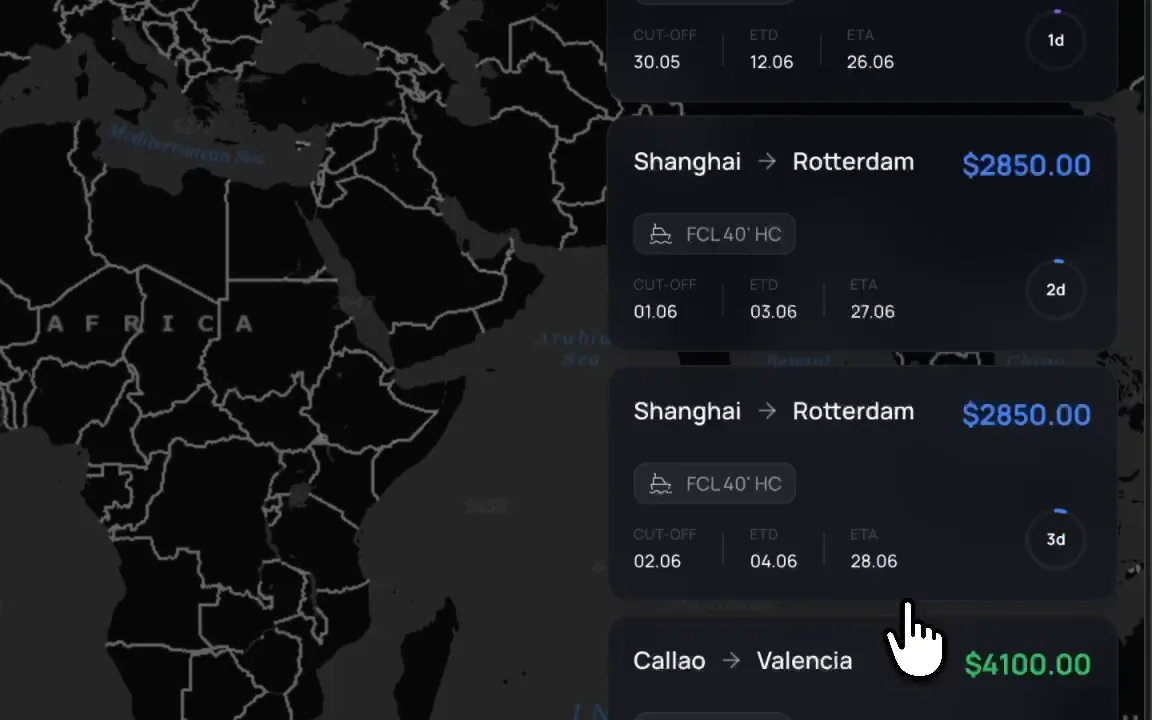
Port-to-port offers appear on a live map. Each shows the carrier, container type, cut-off, departure, arrival, transit time and price, so the shipper compares facts instead of waiting for an e-mailed quote.
Every offer comes in three rate tiers: Standard, Flexible and All inclusive. The tiers state free time, cut-off flexibility, demurrage and support level up front. This is freight rate management at the point of choice: freight rates and their rules arrive together, as part of the offer, not as small print.
Booking and chat on the shipment
The booking flow takes the shipper through the rate tier, the sailing, a booking summary with Incoterms and the confirmation steps, with the total per container shown. Nothing is charged until the agent confirms availability.
Every booking has its own chat with the shipment coordinator, next to the system notifications. A shipment list shows each booking's status, and a tracking view adds shipment visibility. The conversation stays attached to the shipment it is about, not to someone's inbox.
Draft bill of lading
The platform generates a draft bill of lading from the booking, with transport details and cargo particulars; vessel, voyage and ports appear on every document. The agent reviews the draft instead of retyping it.
The electronic bill of lading (eBL) is a separate matter. DCSA publishes a standard for the electronic bill of lading; this note makes no eBL claim for Smart Freight. What the platform produces is a draft for the agent.
One record from offer to bill of lading
The sequence below is the core of the product. Each step belongs to the same shipment record; none starts from a blank form.
- 01Route offerCarrier, container type, cut-off, schedule and price on a map.
- 02BookingRate tier, sailing, summary with Incoterms, confirmation steps.
- 03Shipment chatCoordinator conversation and system notifications on the booking.
- 04Draft bill of ladingGenerated from the booking; the agent reviews, not retypes.
For anyone planning digital freight forwarding, this is the part of freight forwarding software development that matters most. The costly errors sit between the steps, not inside them: a wrong container type on the offer becomes a wrong booking and then a wrong document. When the booking, the conversation, the notifications and the draft bill of lading share one shipment, nobody retypes what the system already knows.
Freight forwarding software development: how Smart Freight was built
Smart Freight is a client product. Logics7's role covers product structure, the web platform, the booking workflow and document automation, from 2024 to the present. The technical building blocks are a web platform, maps and routing, real-time chat and document generation.
Three decisions shaped the product:
- Offers, not quote threads. The shipper compares facts on a map instead of waiting for an e-mail.
- Rules as part of the product. Free time, cut-off and demurrage belong to the offer, not to the small print, and nothing is charged until the agent confirms availability.
- One record. The booking, the conversation, the notifications and the documents share the same shipment.
None of the three is a technology choice. Each decides how the transaction works for the shipper and the agent, and the code follows from it. That is the principle behind how Logics7 works: no development without product logic.
What it proves: build or buy for forwarders
It proves that a transaction where price, rules and documents have to agree can run as one product rather than as a chain of e-mails, without a transformation programme.
For forwarders and NVOCCs, the first question in freight forwarding software development is build or buy, and it comes down to where the difference sits. Packaged forwarding suites and NVOCC software cover common back-office work: documentation, customs, invoicing, EDI/API integration with carriers, links to a TMS or a CRM. If your process matches the package, buy it. Custom logistics software makes sense when the customer-facing transaction is the product: how offers are shown, how rules are stated, how a booking becomes a document.
The same logic applies to booking marketplaces, customer status portals, shipment tracking, invoicing and document automation, and operations dashboards. For a new standalone product, that is our Product Partnership route. For an existing company whose operations run on people and spreadsheets, it is Annual Product Operations: business process first, then a yearly roadmap executed month by month.
Questions readers ask
What should freight forwarding software include?
It should include one shipment record that the quote, the booking, the messages and the documents share. On that record: offers with freight rates and their rules, a booking request and confirmation flow, shipment tracking, document generation such as the bill of lading, and invoicing. Carrier, TMS or CRM integrations follow from the process.
Build or buy freight forwarding software?
Buy when your process matches a package and the work is back office. Build when the customer-facing transaction is your product: how offers, rules and documents reach the shipper. Smart Freight is an example of the second case. Either way, freight forwarding software development starts with the business process, not the tool.
What is an electronic bill of lading?
An electronic bill of lading (eBL) is the digital form of the bill of lading, the ocean transport document that records the goods, the shipper and the consignee and can act as the document of title. DCSA publishes a standard for it. Smart Freight generates draft bills of lading for agent review; we make no eBL claim for it.
Written by

Gozel Annayeva
Head of Product Delivery
Leads each client from signed scope to operating results, with reporting and insights built into every delivery.
Meet the team
Working on something similar? Start a conversation.
A new product, a business process, a live product, a grant application or an introduction — a few lines are enough to find the right next step.
We reply within one working day.